

If you’re leading a small team, running a local business, or guiding a nonprofit board, you’re probably feeling it: the swirl of decisions, deadlines, and distractions that show up this time of year. Everyone’s busy. Everything feels urgent. And clarity gets buried.
Last week we asked all the right questions using our Clarity Card, a simple tool to help leaders pause, refocus, and move forward with intention. Here are five quick checks I use with SMB owners and other leaders to cut through the fog and get started with the first thing first.
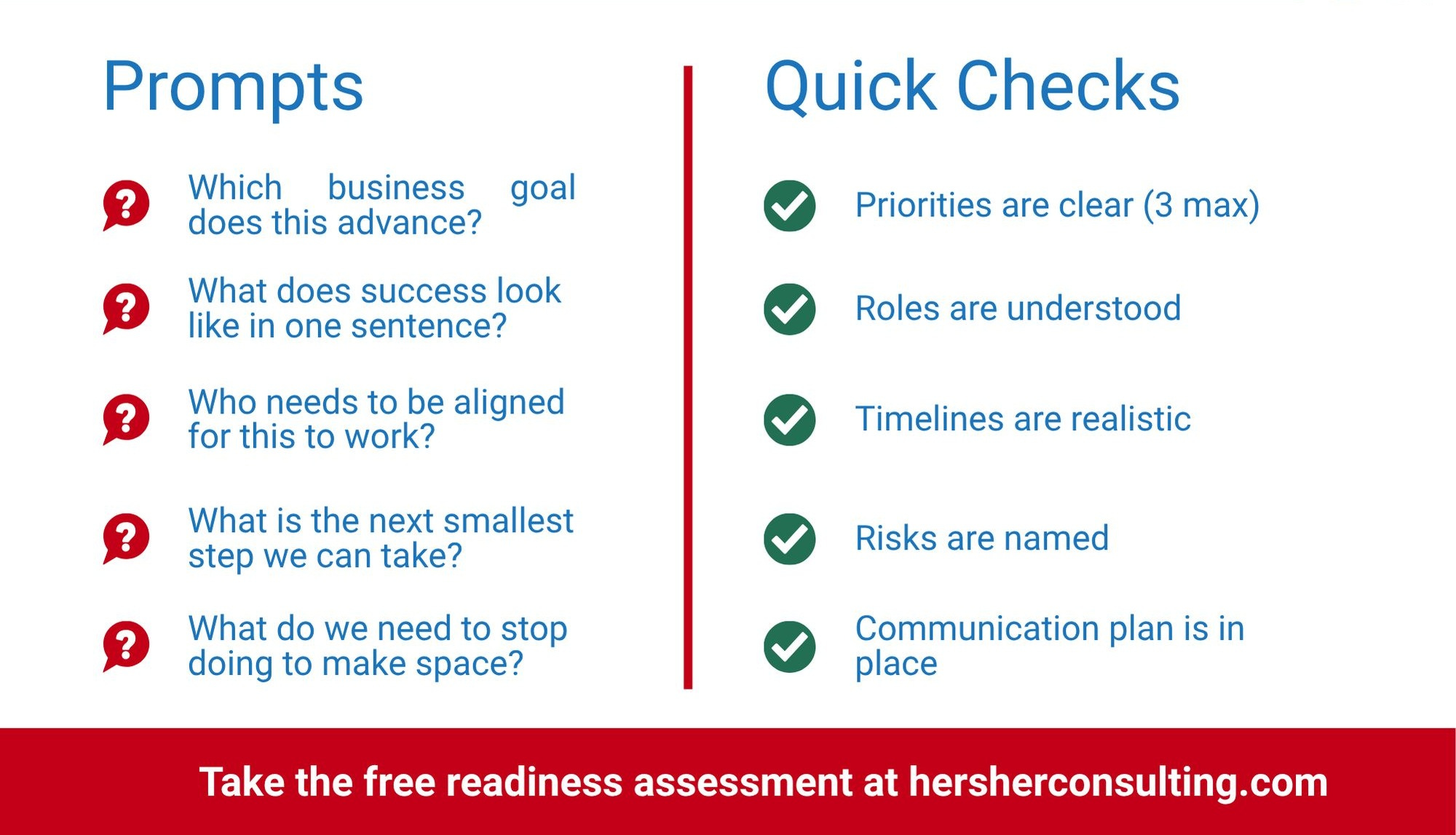
1. Are priorities clear? (Three max)
We’ve all heard the saying: “If everything’s a priority, nothing is.”
It’s the first prompt on the Card and one of the first questions we ask leaders during a Clarity Sprint discovery session. “What business goal does this advance?” Notice, the question is proactive, not reactive. “Goal” not “problem.”
The reason we ask is that teams should limit their focus to three core outcomes. Then, write them down. Share them. Protect them.
Productivity starts with constraint.
“Productivity starts with constraint. Clarity starts with asking the right questions.”
2. Do people understand their roles?
Confusion isn’t just inefficient. It’s exhausting.
Make sure everyone knows what they own, what they support, and what they can ignore. It’s also in this role clarity that people understand the WIIFM (What’s in it For Me?), a key driver for building the desire for change.
Clear roles reduce friction, build trust, and power change.
3. Are timelines realistic?
Urgency is fine. Fantasy isn’t.
If your calendar is built on best-case scenarios, you’re setting your team up to fail. Build in breathing room. Ask your team, “what do we need to stop doing to make space for this objective?”
4. Have risks been named?
You can’t manage what you won’t name.
Call out the dependencies and the “if this breaks, we’re stuck” moments.
Naming and planning for risk is leadership. It’s not resistance or pessimism.
5. Is there a communication plan?
Don’t assume people will “just know.”
Decide how updates flow, who shares what, and when. Who needs occasional updates? Who needs more frequent communication?
It doesn’t need to be complicated. Even a simple rhythm—weekly check-ins, shared notes, one point of contact—can change everything.
Final Thought
You don’t need a multi-day retreat to find clarity. But you do need a moment of pause—and someone who knows how to guide it.
That’s what our Clarity Sprint is built for: a focused, high-impact workshop that helps small teams name what matters, align around it, and move forward with confidence. All in just 90 minutes.
If your organization is navigating change, planning for next year, or just trying to finish strong, let’s talk. I work with businesses, nonprofits, and civic groups to turn complexity into clear next steps.
Not sure where your team stands—or where to begin? Take our no-obligation readiness assessment. A few multiple-choice questions can put you on the road to clarity. And confidence
Ready to move from swirl to structure?
Book a Clarity Sprint or grab the printable Clarity Card on our LinkedIn page. Let’s help your team finish strong.