

It’s the fourth quarter and if your yearly planner looks anything like mine, you are trying to assess progress on a handful of remaining goals and decide where to invest your limited time, energy, and budget.
Using a quarterly planner (Full Focus, by the way) forces me to evaluate every goal each quarter and decide which are achievable and still make sense in a dynamic world.
In my quarterly reviews, I ask the same questions over and over and encourage my clients to do the same.
I’ve pulled the five prompts I use for goal-setting and prioritizing, along with a quick checklist, together into the Clarity Card for quick reference. Here are the five prompts and why they matter.
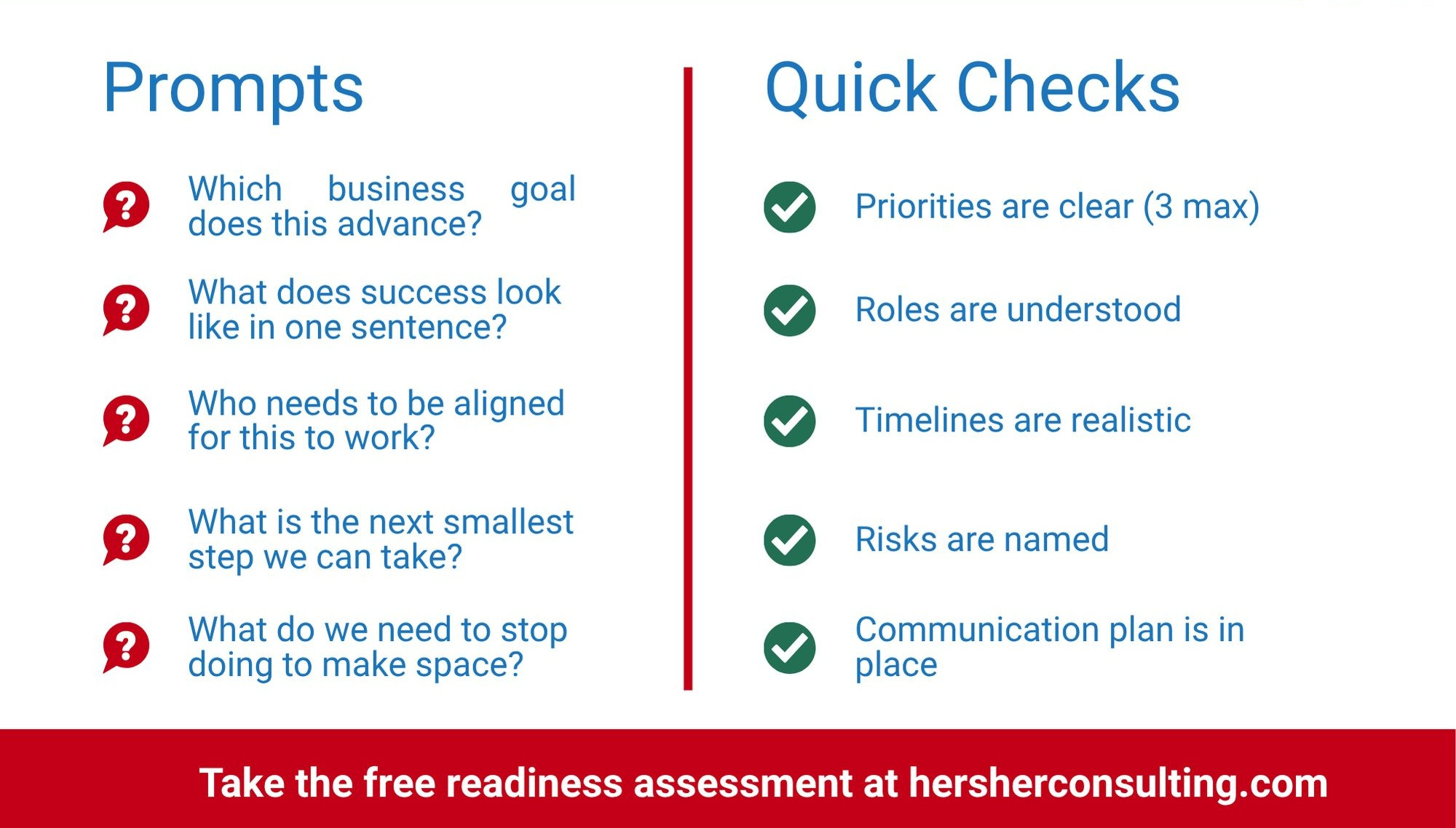
Prompt #1: Which business objective does this advance?
Ask this question first for two reasons. First, it ensures that the time, money, and resources spent accomplishing this goal are aligned with your highest-level objectives. This calls back to the famous Drucker quote:
“There is nothing so useless as doing efficiently that which should not be done at all.”
Second, by framing the question as ‘what goal’ instead of ‘what problem,’ you drive toward objectives instead of chasing symptoms. For example, how many times have you been part of a meeting to talk about a problem that started with ‘communication’ being named as the culprit? But, it’s rarely the true challenge. Overwhelm, misalignment, change fatigue, and shifting priorities all can feel like communication problems.
Prompt #2: What does success look like in one sentence?
We use this question to get crystal clear on the definition of success. Like a SMART goal, or other framework, the best outcomes start with the clarity of a single sentence aligned to a business objective.
Prompt #3: Who needs to be aligned for this to work?
Answering the first two questions without this one is just noise. This is where we identify everyone involved in the effort, along with their needs, motivations, and their influence. A full consideration of this prompt creates a list of what’s in it for everyone and how to make sure that they get it.
Prompt #4: What is the next smallest step we can take?
We’ve all seen posts about the power of compounding change or eating an elephant one bite at a time. Even with the well-known clichés, how many times have you been part of something that became so large that it not only never finished, but it also lost any sense of its original purpose? Zombie Projects are real and they feed on your time and money.
Asking this question, and then asking it again and again, keeps the effort manageable and aligned and unlocks value with each iteration.
Prompt #5: What do we need to stop doing in order to make space?
This brings us back to Zucker and closes the circle. Prioritization is as much about knowing what not to do as what to do first. Especially when your focus and resources are limited.
Need an extra hand sorting through your priorities?
Whether you need an hour or an expert on speed dial, we’re offering our popular Clarity Bundle at a discounted rate during the fourth quarter. Visit hersherconsulting.com and end 2025 with clarity and start 2026 with renewed focus:
Strategic Office Hour: Designed for leaders who want targeted help with real-world challenges: prioritization, stakeholder prep, meeting strategy, or just untangling the fog.
Clarity Sprint: Helps small teams name the real need, define success in plain language, and take the next smallest step—with calm, strategic momentum.
Retained Advisory and Retained Advisory Plus: for SMB leaders heading into year-end with too much on their plate and not enough strategic bandwidth, the Q4 Retainer Sprint offers calm, consistent guidance—on demand and without the complexity of a full engagement.